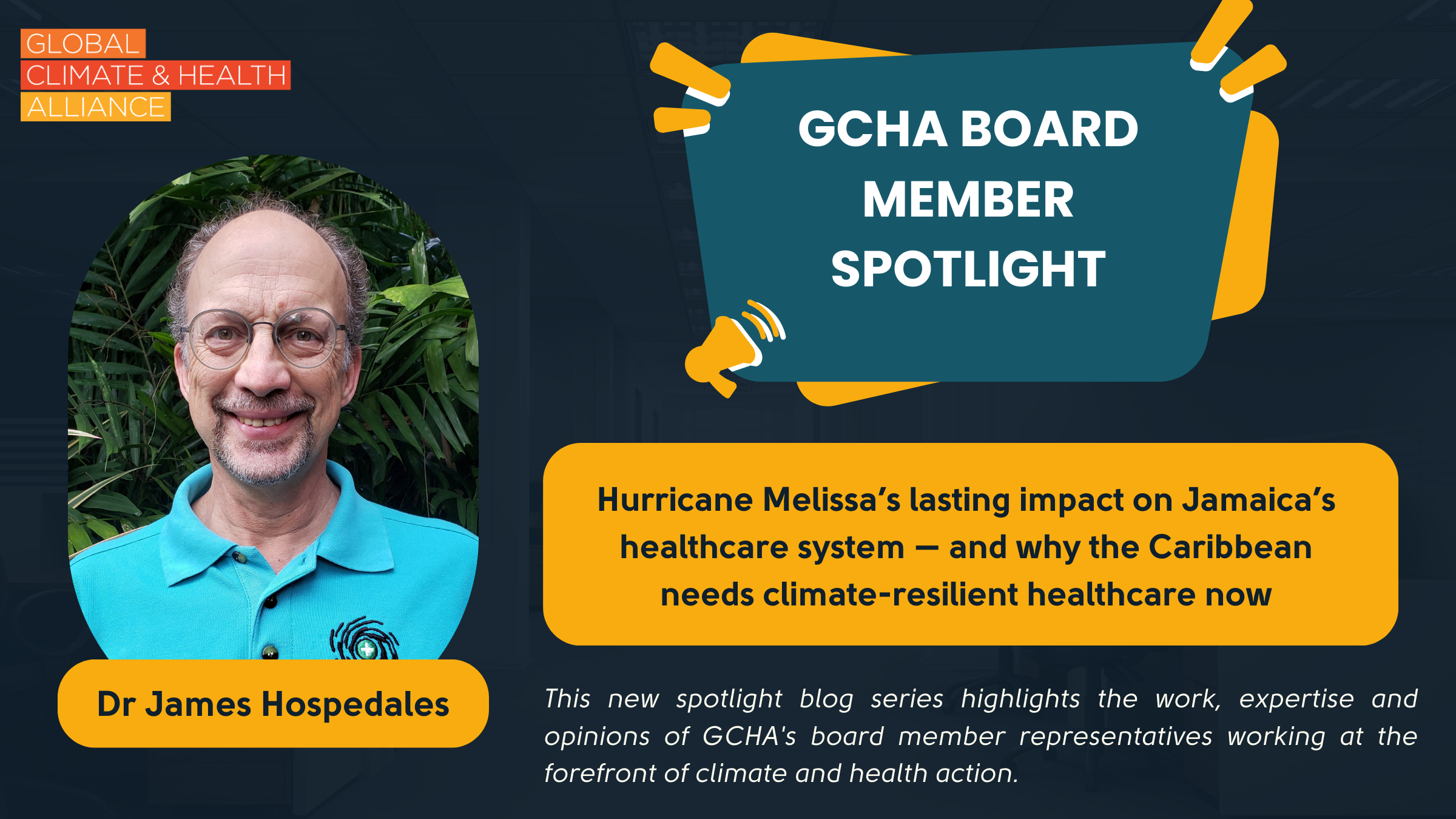
This blog post is the first in our new GCHA Board member authored series highlighting the work, expertise and opinions of GCHA’s board member representatives working at the forefront of climate and health action. These spotlight posts will share stories, examples, knowledge and practical advice on tackling climate and health issues around the world.
This first post is by Dr. James Hospedales. Dr. Hospedales is a citizen of Trinidad and Tobago with over 30 years of experience in public health in the Caribbean, USA and UK. He is a strong advocate for climate action and in 2020 he founded the EarthMedic and EarthNurse Foundation for Planetary Health to mobilise health professionals and others to address the climate and health crisis. Dr Hospedales previously served as Executive Director at the Caribbean Public Health Agency (CARPHA) and was responsible for the PAHO/WHO program for prevention and control of chronic noncommunicable diseases (NCDs).
I served on the Pan American Health Organization (PAHO) Caribbean Disaster Response Team in the 80s and 90s. My first mobilisation was to Jamaica after Hurricane Gilbert in 1988, a Category-3 hurricane (111-129 mph winds), which caused enormous damage to all sectors, including health. In the years since, I’ve seen firsthand that climate change is increasingly fuelling more destructive hurricanes that intensify faster, grow stronger and wetter and linger longer.
When Hurricane Melissa made landfall in Jamaica on 28 October 2025 as a Category-5 storm (157+ mph winds), it didn’t just tear up roofs and roads—it again exposed the hard reality that a healthcare system can’t protect lives if it can’t stay standing, powered and staffed during and after extreme weather events. A task which takes planning and rehearsing at all levels.
Hurricane Melissa had a devastating effect, particularly on the nation’s Western health systems and facilities. The Black River Hospital to the South-West of the island was left in ruins with flooded wards and roof damage. Savanna-La Mar-Hospital to the West saw significant damage to several departments, and its field hospital was completely destroyed. Falmouth Hospital to the North of the Island was hit with widespread destruction, water damaged equipment and a flooded boiler room. Many other facilities in the Western parts of Jamaica were left in-operational with power and water outages, resulting in widespread patient evacuations, compounded by damaged roads, bridges, and communications.
In the weeks following, national partners and volunteers from across Jamaica banded together with international partners to provide emergency support, aid, and personnel to help support the country’s health system, but the impacts on Jamaica’s health system continue to unfold long after the emergency teams have left. Months later the country is still grappling with interrupted care, service disruption, patient backlog and a strain on mental health services.
Hurricane Melissa is a repeat warning signal for Jamaica and for the wider Caribbean: climate shocks are health shocks, and climate-resilient health systems must become national and regional priorities.
Lasting impact on health
In the immediate aftermath of Hurricane Melissa, many Jamaicans faced injuries, displacement, and the day-to-day realities of disrupted water, sanitation, and shelter—conditions that raised risks for multiple water-borne and vector-borne diseases. A few weeks after the Hurricane the country reported an outbreak of leptospirosis, linked to increased exposure to contaminated floodwater and soil. Other countries affected by Hurricane Melissa have reported rising cases of chikungunya, cholera and dengue, as storms and flooding created ideal breeding sites for mosquitoes.
Jamaica’s affected communities are also experiencing a rise in mental health conditions exacerbated by the trauma of the hurricane and its aftermath. Dr. Brian Kazaara, President of the Jamaica Psychiatric Association has noted how often there is a rise in delayed onset PTSD 6 months + following natural disasters, once victims begin to emerge from survival mode and have time to reflect on the traumatic events.
Hurricane Melissa exposed a key vulnerability in the healthcare systems of several countries across the Caribbean: That when a country is cleaning up and rebuilding, public-health risk prevention becomes harder at exactly the moment it becomes most important. Research into this situation –what works and what to do differently next time– is important, including how to manage the the considerable excess deaths likely in the months following a major storm, as Puerto Rico experienced after Hurricane Maria in 2017.
Lasting impact on health systems, infrastructure and facilities
Health systems don’t fail only inside hospitals; they fail when the lifelines around them also suffer. After Hurricane Melissa, Jamaica grappled with major infrastructure disruption across affected areas, with recovery hampered by blocked roads and service interruptions, exactly the conditions that delay emergency response, disrupt supply chains, and make it harder for patients (and staff) to reach care.
Months on, Jamaica’s health system remains significantly strained. With so many facilities damaged during the hurricane, temporary and mobile medical units are continuing to fill the health services access gap left in the wake of Hurricane Melissa. PAHO reports that many of the hospitals that are up-and-running are overrun and experiencing disruptions, patient backlog, overcrowding and staffing issues whilst dealing with damage and loss to infrastructure, facilities, equipment and medicine.
Post Hurricane Melissa, Jamaica’s healthcare system now also must deal with a resulting double burden. More people need care (injuries, infections, chronic disease exacerbations, patient backlog), while the system’s capacity shrinks- underlining why resilience must be built into healthcare systems across the Caribbean before the next storm arrives.
To ensure that health systems can remain functional in the face of future extreme weather events, climate resilience must be built into every aspect of the system– including governance/policy and plans, financing, human resources, services delivery, communications networks, early warning systems, medicines and vaccine supply and transportation.
An urgent need for climate resilient health systems in the Caribbean
2026’s hurricane season is only a few months away, but Jamaica’s healthcare system is still recovering from the destruction caused by both 2024’s Hurricane Beryl and 2025’s Hurricane Melissa, which claimed 102 lives across the Caribbean, including 54 in Jamaica. As the frequency and intensity of hurricanes continue to rise in the face of climate change, the Caribbean remains increasingly vulnerable to the compounding effects of extreme-weather events, particularly as many health facilities and the majority of populations reside in coastal areas.
Climate resilience must be built or retrofitted into health systems and hospitals- structurally and operationally. The PAHO Smart Hospitals Initiative is designed to do just that; to keep health facilities functional during, and after, disaster strikes. This means prioritizing flood protection, wind resilience, backup power, water storage/treatment, and protecting supply rooms— especially for major hospitals.
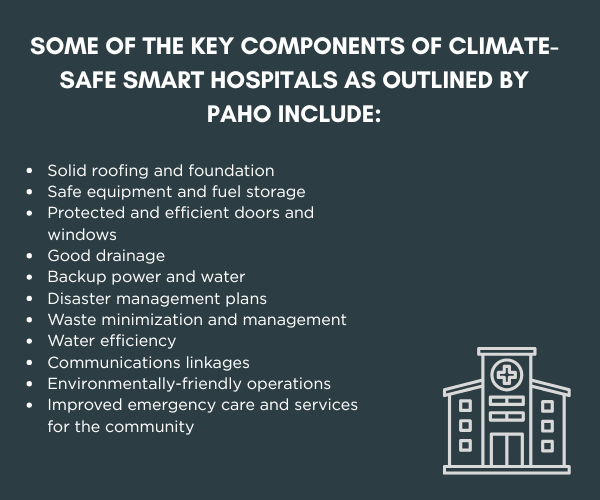
See the full list of key components of climate-safe smart hospitals as outlined by PAHO here.
A climate-resilient health system is one that can anticipate climate shocks, absorb them, keep delivering care, and recover fast, while protecting patients and staff from the second wave of harm that often follows the first storm.
This month CARICOM Chief Medical Officers will gather in Guyana to discuss the region’s most pressing health matters, and I hope that climate resilience will be prioritised, and most importantly, actioned. Climate resilience must be financed before disaster strikes, not after. It is cheaper—and far less deadly—to invest in climate resilient healthcare, than to deal with the compounding and devastating effects of the climate crisis on underprepared and overwhelmed health systems.