View the Global Climate and Health Alliance submission to the Santa Marta conference
Santa Marta, 20 April 2026:- Ahead of next week’s Santa Marta Conference on Transitioning Away from Fossil Fuels in Colombia, the Global Climate and Health Alliance, a consortium of over 250 health organisation, is calling on the more than 50 participating national governments to push human health to the forefront of national plans to end global fossil fuel dependency.
In its submission to the conference, the health community urges governments to fully account for the often-overlooked health costs of fossil fuels in budgets, energy planning, and investment decisions.
The submission also calls for an urgent phase-out of fossil fuel subsidies, removal of the industry’s social license through restrictions on advertising, sponsorship, and partnerships, and the adoption of strong legal accountability frameworks, including operationalizing the ICJ Advisory Opinion, to hold governments and corporations accountable for these harms.
“Fossil fuels are health-harming products – governments must act to protect people and the planet from the damage they cause”, said Dr Jeni Miller, Executive Director of the Global Climate and Health Alliance. “Governments meeting this week in Santa Marta must put the health of everyone at the center of discussions, and commit to ending dependence on these dangerous fuels.”
“Transitioning away from fossil fuels isn’t simply a question of energy or economics – regulating their use and phasing them out is crucial for human health and well-being, not just a side benefit” said Miller. “By focusing solely on carbon, energy, and economics when discussing climate, we risk missing what’s really at stake – people’s health. Fossil fuels are causing immediate harm – phasing them out is not only about protecting the planet but also about saving lives in the near term, reducing strain on health systems, and creating greener, more just, and healthier societies.”
“By integrating health evidence, including health-related costs and savings, into national climate and energy policy, every government represented in Sant Marta can drive the transition from fossil fuels not only as an environmental necessity, but as one of the most powerful public health interventions of our time”, added Miller.
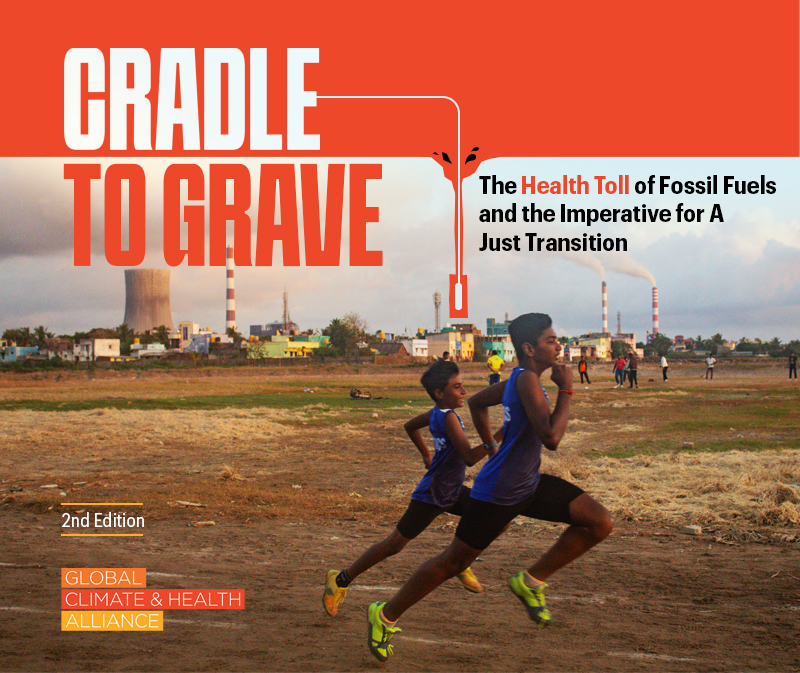
A recent report by the Global Climate and Health Alliance, Cradle to Grave: The Health Toll of Fossil Fuels and the Imperative for a Just Transition shows strong evidence that along with causing climate change, fossil fuels also harm health at every stage of the industrial cycle, from extraction and processing to transport and burning, and every stage of the human lifecycle from fetus to childhood to elderly.
The Health Cost
“Health and health systems remain largely absent from fossil fuel transition plans”, said Dr Courtney Howard, MD Global Climate and Health Board Chair, and Emergency Physician in Yellowknife, Canada. “Producer fossil fuel subsidies put our tax dollars in service of death and health system destabilization. Policy debates focus on energy security, growth, and emissions, while overlooking the health and economic costs borne by people and public systems, as well as the significant benefits of lower healthcare costs, higher productivity, and more resilient economies.”
“Now is the time to prioritize health in transition planning and include health costs in economic decisions”, Howard added. “These costs are rarely reflected in budgets or energy plans, while fossil fuels continue to receive significant subsidies. This conceals their true price and makes the transition appear costly, when in fact, the burden falls on health systems. Ending fossil fuel use will save lives and reduce expenses.”
Air pollution alone costs the global economy approximately $8.1 trillion each year in healthcare, lost productivity, and premature deaths, out of a total global economy of about $120 trillion.
“Governments must integrate health into budgets, national accounts, and energy policy”, concluded Howard. “This includes health impact assessments, incorporating health into cost-benefit analyses, and accounting for full lifecycle harms. Making these costs visible demonstrates that phasing out fossil fuels is both environmentally necessary and economically sound, reducing long-term public spending and improving overall health and well-being.”
Ending Fossil Fuel Subsidies
“Fossil fuel subsidies channel public money into an industry that drives disease and premature deaths and yet governments continue to fund it,” said Jess Beagley, Policy Lead at the Global Climate and Health Alliance. “This must change.”
“Just and equitable subsidy reform should be recognized as a public health measure”, added Beagley. “Redirecting these funds to clean energy will generate huge savings than in turn allow for greater investment in public goods like healthcare, education and social protection, providing immediate benefits and supporting vulnerable communities.”
“The public should not bear the cost of fossil fuel harms; polluters must pay and be held legally accountable for their impacts on health and lives”, said Beagley.
Challenging the Social License of the Fossil Fuel Industry
“Despite everything we know about the environmental and health harms from fossil fuels, the industry still wields enormous influence over our daily lives through advertising, sponsorships, public relations, and partnerships – even in the health sector”, said Shweta Narayan, Campaign Lead at the Global Climate and Health Alliance. “The public health community has seen the consequences of such influence before, and the fallout is undeniable.”
“Governments gathering in Santa Marta must resolve to revoke the social licence granted to the fossil fuel industry, as was achieved with tobacco control, by banning ads for dangerous, health-harming fossil fuels, ending sponsorship of organizations and events and establishing clear conflict of interest rules”, added Narayan.
Legal Accountability
The Global Climate and Health Alliance believes Santa Marta Conference also provides a critical opportunity to connect transition discussions with emerging legal frameworks and accountability mechanisms. Recent developments, including advisory opinions from international courts and the growing recognition of the right to a clean, healthy, and sustainable environment, are opening new pathways to hold both states and corporations accountable for the harms caused by fossil fuels.
“Santa Marta provides a platform to implement the ICJ Advisory Opinion on states’ legal duties related to climate change, promote accountability and justice, and emphasize that moving away from fossil fuels is a legal and moral obligation rooted in health and human rights”, said Narayan.
Further quotes:
“Championing a fossil fuel-free world is one of the most important actions that health professionals can take to ensure the health and well-being of everyone alive today”, said Ed Maibach, Global Climate and Health Alliance board member representing the Medical Society Consortium on Climate and Health. “The health benefits of a fossil fuel phase-out are profound, fast-acting, and can last a lifetime—for babies and children.”
Smoke from wildfires exposes 354 million people to increased air pollution, leading to over 82,000 premature deaths globally.
“As an emergency physician in the Canadian subarctic, I serve a majority Indigenous population that extends to the high arctic across an area larger than France and Spain combined”, said Dr Courtney Howard, MD Global Climate and Health Board Chair, and Emergency Physician in Yellowknife, Canada. “In 2023 wildfires forced the evacuation of our hundred-bed hospital, our inpatients were flown down to Vancouver by a military evacuation plane. Emergency evacuation of 70% of a territory’s population was traumatizing for both patients and health professionals. The costs were staggering.”
“Workforce-related health system strain is already stretching healthcare around the world”, added Howard. I’m incredibly proud of what we have managed to do in response to the Canadian wildfires, but the reality is that health systems are not ready for a new normal. With the subarctic already warming at triple the global rate, we’re already living with and dealing with a future that the rest of the world has yet to experience.”
“The World Health Organization’s, Delivering the Belem Health Action Plan provides advice for adapting health systems to climate change”, said Howard. “Yet it also says, “The evidence is clear: urgent and sustained mitigation across all sectors is the single most important health adaptation intervention. There are profound physical, financial, and technological limits to adaptation, and health systems cannot remain resilient in a world of unchecked warming.”
“The evidence is already clear and overwhelming: climate change is harming health in profound ways, today and everywhere,” said Dr Marina Romanello, Executive Director of the Lancet Countdown on Health and Climate Change. “While we see that health impacts are breaking new records, our research also shows that climate action delivers some of the greatest health opportunities of our time – from cleaner air and healthier cities to reduced disease burden and stronger health systems. Phasing out fossil fuels is not only about preventing future harm; it is about protecting lives and improving health now.”
“In my and my colleagues’ research around the globe, we are witnessing the devastating health impact from fossil fuel extraction, refining, combustion, and related petrochemicals. Every health impact of fossil fuel is a violation of the right to a clean environment,” says Ebba Malmqvist, Associate Professor at Lund University and chair of the International Society for Environmental Epidemiology Policy Committee. “But we can also see the health benefits in communities when, for example, a coal power plant has been shut down or when exhaust emissions from traffic are reduced.”
“After 30 years of paralysis at COPs, Santa Marta offers a historic moment for ambition to flourish without the obstruction of big polluters”, said Dr. Leah Temper, Health and Economic Policy Program Director, CAPE. “The health community learned with the tobacco treaty that to put in place health protective policies we need to stem industry interference. As the world goes through the biggest energy supply shock since the 70s, the health movement’s message is that a post-fossil economy will be more resilient, healthier and can deliver greater justice and well-being. We are calling for a fossil ad ban and limits on lobbying in the roadmap to ensure that fossil fuel interests cannot drown out our calls with their fear-mongering, false solutions and promotion of health-harming products.”
“Evidence of health damage, especially associated with coal-fired power plants in Chile, has shown that they affect respiratory and cardiovascular health and increase cancer rates in communities that have been exposed to these emission sources for a long time”, said Dr. Sandra Cortés, Chair of the Scientific Committee on Climate Change – Chile, Professor, Catholic University of Chile. “Reducing exposure through various regulatory mechanisms, including the closure of coal-fired power plants, has clearly resulted in an improvement in the health conditions of these communities. Chile’s example in reducing exposure through various mechanisms has proven to be an effective public policy aimed at protecting people’s health, especially children and women among the most affected.”
ENDS
Contact:
Dave Walsh, Communications Advisor, Global Climate and Health Alliance, [email protected], +34 691 826 764 (Available from 0630 CET)
About GCHA
The Global Climate and Health Alliance is a consortium of more than 250 health professional and health civil society organisations and networks from around the world addressing climate change. We are united by a shared vision of an equitable, sustainable future, in which the health impacts of climate change are minimised, and the health co-benefits of climate change mitigation are maximised.
Find out more: https://climateandhealthalliance.org/who-we-are/about/