© WHO / Laurent Chambost
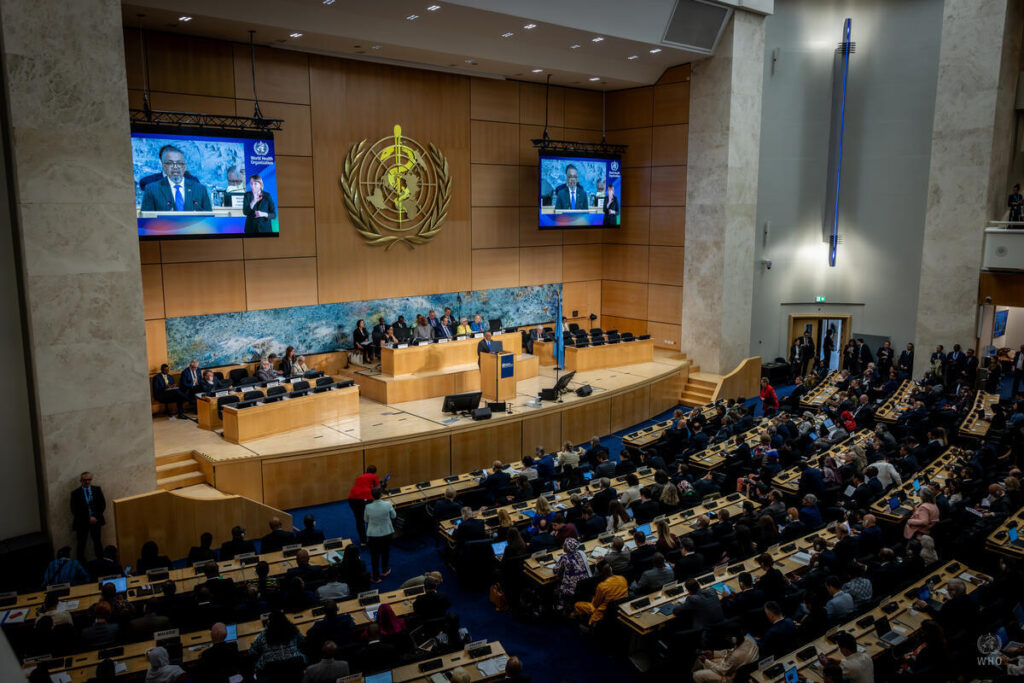
Geneva, 28 May 2026:- Following last week’s 79th World Health Assembly, the Global Climate and Health Alliance, representing over 250 health organisations, is urging governments and the World Health Organization to integrate climate change considerations into and across all areas of global health planning, programs and policy, and to recognize the profound health harming impacts of the primary driver of climate change, fossil fuels.
“Climate and health are inseparable in practice and should so be in policy”, said Rosie Tasker, Climate and Clean Air Liaison at the Global Climate and Health Alliance. “Climate is a factor in nearly every area of work addressed during this year’s assembly; health and climate are intertwined in real life, so governments must integrate climate across health national policies.”
“Climate change is driving increases in heat-related illness and death, spreading infectious diseases, and more acute mental health impacts, all of which are straining already fragile health systems”, she added. “While climate change and air pollution have common drivers, climate change is exacerbating the impacts of air pollution, driving up the burden of cancers, cardiovascular disease, and respiratory conditions.”
“To truly protect and advance global health in the era of climate change, the World Health Organization and health ministries must ensure that climate change is recognised and responded to in all areas of global health planning, programs and policy”, said Dr Jeni Miller, Executive Director of the Global Climate and Health Alliance.
WHA 79 worked from a strong foundation as WHO’s current General Programme of Work, running from 2025 to 2028, recognises the health impacts of climate change as the first of six priorities for the organisation. During a high-level event on the Belem Health Action Plan during WHA79, Dr Jeremy Farrar, the WHO Assistant Director General for Health Promotion, Disease Prevention and Care, underscored how critical climate and health work is to the organisation as the most tangible impact of climate change on people’s lives.
While climate and health was not a specific issue on the agenda of WHA79, eight agenda items touched on climate-related issues, however it was missing from several key discussion items. The Global Climate and Health Alliance noted the omission of climate from discussions on global health architecture reform during the meeting.
While the proposal focused on the process, not the content of these reforms, two key concerns were highlighted by numerous members of the Alliance. Firstly, the current joint taskforce does not include any agency or body with responsibility for climate and health and, while many of the proposed members do touch on climate in their work, there is no clarity on who can be held accountable for ensuring that this new architecture recognises and responds to the magnitude of the challenge that that climate crisis poses for health. Secondly, that the taskforce does not include any representatives of civil society organisations or communities, to raise the perspectives of those most acutely affected by the health impacts of the climate crisis. As a result, there are fears that the topic may fall between the cracks.
Climate Change Health Impacts
Climate change affects people’s health, by increasing risk of disease, impacting health systems along with the systems which safeguard our health and wellbeing, such as food.
Non-communicable diseases, including diabetes, cardiovascular and kidney diseases, are aggravated by air pollution and by heat. Malaria and neglected tropical diseases are shifting to new geographies and affecting different populations due to global heating. Climate-induced extreme weather events or wildfires can result in post-traumatic stress disorder, while climate anxiety is having measurable effects on mental health around the world.
Access to health care is made more challenging by floods and fires that destroy clinics and medical records and put severe strain on healthcare providers, meanwhile health systems bear the costs of the health impacts from fossil fuels, often without recognizing this. Maternal and child health are impacted by food shocks due to climate change, and by climate-induced migration.
“The health community is currently under tremendous strain”, said Dr Jeni Miller, Executive Director of the Global Climate and Health Alliance. “The abrupt and unconscionable withdrawal of US international aid, and decreasing aid budgets from other developed countries, have left ministries of health and health agencies and organizations in developing countries scrambling to fill the gaps, while cuts to WHO funding by the US and others require major internal reorganization of the world’s global health anchor institution.”
“Within many developed countries, public funding is being re-routed to security and away from health, climate and social welfare”, said Miller. “These are heavy challenges, and it might be tempting for governments to let climate change fall down the health agenda. That would be a mistake – failing to plan for the impacts of climate change, on all health issues, will leave countries far more vulnerable to climate-exacerbated crises, driving far greater health impacts, and creating their own security concerns.”
“Every country should continue working to incorporate climate change into health planning; even as countries grapple with current geopolitics, they must value the investment in stabilizing health systems and public health as vital to all forms of security”, concluded Miller. “Kudos to WHO for continuing to prioritize climate change in its health work; and where strategic support can be provided by philanthropy it should be.”
“With the UNFCCC’s Bonn SB 64 (8-18 June) on the horizon, governments must also consider how to embed health across their climate policies and plans”, said Jess Beagley, Policy Lead at the Global Climate and Health Alliance. “This must be supported by decision-making at the international level, including the tripling of adaptation finance, a robust and well resourced just transition mechanism, and sustaining the call in the outcome of the first global stocktake for a just, orderly and equitable transitions away from fossil fuels as preparations for the second Global Stocktake progress.”
New WHO Director General in 2027
The current process for electing a new World Health Organization Director General is currently in progress, with the incumbent, Dr Tedros Adhanom Ghebreyesus due to stand down in August 2027, following the appointment of his replacement during the May 2027 Eightieth World Health Assembly.
”The next Director General of WHO will inherit the post at a time of immense strain on global health systems worldwide, and geopolitical turmoil that undermines the protection of people’s health”, said Miller. “The impacts of ongoing cuts to international aid continue to be felt by communities throughout the developing world, and in the health ministries and health systems charged with caring for them.”
“The rise of conflicts and weakening of international treaties and agreements is causing governments to redirect public funds into military and security, but while these immense challenges rightly draw significant attention, climate change acts as a threat multiplier in all cases”, added Miller.
“Healthcare provision is aggravated by heat, drought and lack of access to clean water, and climate impacts that affect supply chains”, said Miller. “The current dependence of health systems, food systems, and livelihoods, on fossil fuels has made them highly vulnerable to shocks to fossil fuel access. While security concerns are on the rise, climate change as itself a threat to safety and security, and as a factor that further complicates health protection in conflict zones, is overlooked.”
“Protecting effective WHO governance is paramount, and the next Director General must be clear-eyed about the critical importance of keeping climate change high on the international health agenda across areas of global health work, and in the context of these financial and geopolitical challenges”.
Fossil Fuel Debates at WHA 79
While not on the official agenda of WHA 79, a number of side events on the margins of the assembly highlighted fossil fuels as the primary driver of climate change, and responsible for a wide range of other significant health harms globally. As the root cause of climate impacts, fossil fuels compound the challenge of addressing a wide range of health issues.
“Fossil fuels are health-harming products”, said Shweta Narayan, Campaign Lead at the Global Climate and Health Alliance. “The scientific evidence is unequivocal: coal, oil, and gas damage human health at every stage of their lifecycle – from extraction to combustion to waste disposal – and drive the climate crisis that multiplies this damage to our health. And while access to energy is essential for health and development, use of fossil fuels is not. Global health leaders have led the way before on ways to address health-harming products, from asbestos to tobacco to the misuse of formula milk. The scope and scale of health harm from fossil fuels requires the same response.”
ENDS
Contact:
Dave Walsh, Communications Advisor, Global Climate and Health Alliance, [email protected], +34 691 826 764 (Available from 0630 CEST)
About GCHA
The Global Climate and Health Alliance is a consortium of more than 250 health professional and health civil society organisations and networks from around the world addressing climate change. We are united by a shared vision of an equitable, sustainable future, in which the health impacts of climate change are minimised, and the health co-benefits of climate change mitigation are maximised.
Find out more: https://climateandhealthalliance.org/who-we-are/about/