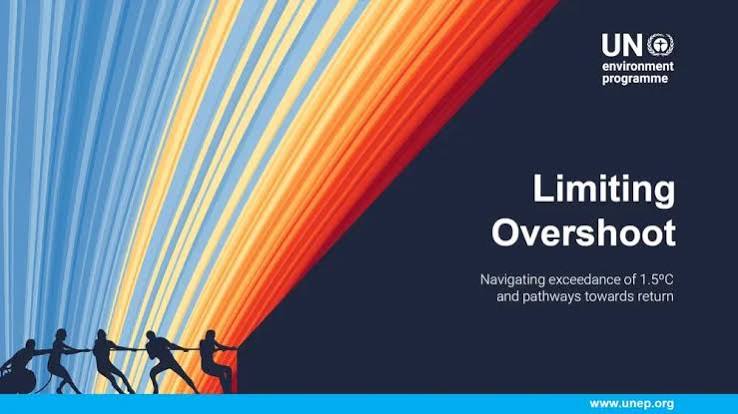
Nairobi, 2 September 2026:- Responding to the publication of the UN Environment Programme report Limiting Overshoot: Navigating exceedance of 1.5°C and pathways towards return, which finds that as “global temperature rise gets set to cross 1.5°C, pushing climate risks and impacts to dangerous new heights, the world must strive to return to below 1.5°C as soon as possible and simultaneously reduce the vulnerability of societies, communities and economies to climate impacts… by acting now to get on an ‘overshoot, peak, and decline’ pathway”, Dr Jeni Miller, Executive Director of the Global Climate and Health Alliance, a consortium of more than 200 health professional and health civil society organisations and networks from around the world addressing climate change, said:
“As communities around the world reel from floods, fires and droughts wrought by climate warming, UNEP’s report is not only a timely reality check, but must spark global action to get us on a pathway that limits overshoot, peaks, and declines to get us back under 1.5°C of warming.”
“As the climate is warming faster than the world is reducing emissions or adapting it is imperative that governments take urgent action to collectively reduce emissions that reverse that warming”, added Miller. “People are already suffering the health impacts driven by the extraction and burning of fossil fuels. We must immediately reduce global greenhouse gas emissions, to ensure impacts do not worsen and become more widespread.”
“At COP31 in Antalya, governments must accelerate momentum towards just, orderly and equitable energy transitions from fossil fuels to renewable energy, and commit to triple public adaptation finance to at least USD$120 billion by 2035, to strengthen systems in the face of the compounded risks associated with overshoot”, said Miller. “For the many communities currently lacking adequate energy, access to clean, modern electricity sources that protect them from the health harming pathway of fossil fuel dependence is essential to health, equity, and sustainable development.”
“As the report’s first-listed action in a section on the importance of near-term mitigation, UNEP notes the imperative to avoid carbon lock-in in infrastructure, including fossil fuels based power plants, transport systems and industrial facilities”, said Jess Beagley, Policy Lead at the Global Climate and Health Alliance. “Fossil fuels are the leading driver of climate change and its associated health harms, such as heat, infectious disease, malnutrition, and mental health impacts. In addition, fossil fuel extraction, processing, transport, combustion and waste harm health through air, water and soil pollution, leading to increased cancers, heart disease, respiratory conditions, endocrine, neurological and developmental disorders. Health co-benefits of the actions proposed by UNEP include cleaner air, improved energy access, and increased physical activity”.
”The report discusses how carbon dioxide removal (CDR), both conventional and novel, is needed to return from an overshoot scenario and rightly points out that it is in addition to, not instead of, deep and rapid mitigation” said Nova Tebbe, Post-Doctoral Researcher at the Global Climate and Health Alliance. “CDR cannot be a replacement of mitigation to solve the much wider health and environmental harms of fossil fuel extraction, processing, combustion and waste. Each CDR method comes with trade-offs and risks for health and should be seriously evaluated including through strong governance to protect us all.”
“UNEP’s report forces us to confront the root cause of the climate crisis: the fossil fuels industry, which for decades has denied, delayed and distorted the evidence of the damage its products cause, while protecting its social licence to continue operating and expanding”, said Shweta Narayan, Campaign Lead at the Global Climate and Health Alliance. “Fossil fuels are health- and climate-harming products, and they must be treated as such. We urgently need a just and equitable transition away from coal, oil and gas, one that protects workers and communities and puts those least responsible, yet most affected, at its heart. The cost of continued delay is not measured only in degrees or dollars. It is paid in the health, lives and futures of millions of people”.
Contact:
Dave Walsh, Communications Advisor, Global Climate and Health Alliance, [email protected], +34 691 826 764 (Available from 0630 CET)
About GCHA
The Global Climate and Health Alliance is a consortium of more than 250 health professional and health civil society organisations and networks from around the world addressing climate change. We are united by a shared vision of an equitable, sustainable future, in which the health impacts of climate change are minimised, and the health co-benefits of climate change mitigation are maximised.
Find out more: https://climateandhealthalliance.org/who-we-are/about/