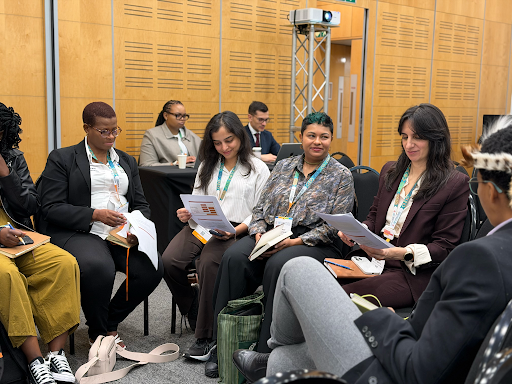
EQUINET Session: Tsepang Molefe, GroundWork South Africa
By Shweta Narayan, Global Climate and Health Alliance
The 18th World Congress on Public Health in Cape Town closed with an unmistakable message: the public health community is increasingly prepared not only to document the health consequences of the climate crisis, but to also confront the systems and industries driving it.
Held from 6–9 September 2026, the Congress brought together more than 2,500 participants from around the world for four days of lively and engaged discussions spanning many of the most pressing challenges facing public health today. Across plenaries, workshops, roundtables and informal conversations, participants explored the changing determinants of health, widening inequalities, environmental threats, health systems, justice and the evolving role of public health in shaping healthier societies.
For the Global Climate and Health Alliance (GCHA) and groundWork, our priority was clear: to strengthen recognition of the climate crisis as a public health crisis, while ensuring that the conversation does not stop at its consequences. If we are serious about protecting health, we must also address one of its central root causes, our continued dependence on fossil fuels.
Our engagement at the Congress was built around a simple proposition: the transition away from fossil fuels is a public health necessity, and public health professionals have an important role in ensuring that this transition is just, equitable and centered on the rights and wellbeing of workers, communities and future generations.
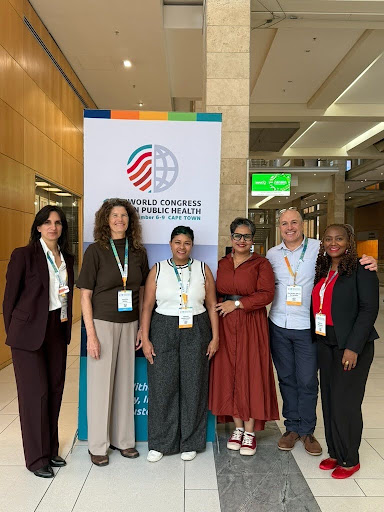
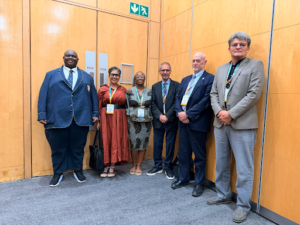
GroundWork and GCHA team (Tsepang Molefe, groundWork South Africa)
From climate impacts to their root causes
Over the years, public health has become increasingly effective at describing what climate change means for people, such as extreme heat, air pollution, food and water insecurity, changing patterns of infectious disease, occupational risks, displacement, and pressure on health systems. These impacts were discussed throughout the Congress. But what was particularly encouraging in Cape Town was the growing willingness to take the conversation further, from describing climate-related health harms to examining the political, economic and commercial systems producing them.
Fossil fuels sit at the center of that discussion, as their health impacts extend beyond the greenhouse gases released when coal, oil, and gas are burned. These harms are present across the entire fossil fuel lifecycle, from extraction, processing, transportation, refining, combustion, and waste, affect all of us, and disproportionately affect workers, frontline communities, and marginalized populations already experiencing social and economic inequality.
That is why the breadth of discussions at the Congress focusing on the fossil fuel industry, its role in the climate and health crisis, and the strategies available to public health to respond was important and significant.
GCHA and groundWork organised three interconnected sessions designed to move participants from understanding the structural problem, to building knowledge, and ultimately towards public health leadership and advocacy. These included “Challenging the Social License of the Fossil Fuel Industry: A Strategy for Public Health and Systemic Change,” “Climate & Health 101: Foundations for Public Health Action in a Warming World,” and “Reclaiming Public Health Advocacy in the Climate Era: Lessons from Health Professionals’ Leadership in Social Justice Movements.”
The first explored how fossil fuel companies maintain their social and political legitimacy, how corporate influence can shape public narratives and policymaking, and what public health can learn from its long experience challenging other health-harming industries. The second focused on strengthening the foundations of climate and health understanding across the wider public health community and discussed effective ways of communicating complicated climate and health science in an accessible manner. The third asked an equally important question: once we understand the evidence, what is the health community’s responsibility to act?
A conversation much bigger than any single organisation
What made the Congress particularly important was that these discussions were not confined to GCHA–groundWork’s program. Across the Congress, other institutions asked complementary questions and explored different tools for confronting fossil fuel-related health harms.
The Wits Planetary Health Research program hosted “A Public Health Approach to Climate Change: Regulating the Fossil Fuel Industry Through Public Health Levers.” Drawing in part on the evidence and framing developed through GCHA’s Cradle to Grave report, alongside important South African litigation including the Deadly Air and Cancel Coal cases, the discussion explored how existing public health powers, regulation and legal approaches can be used to respond to fossil fuel harms. It provided a natural bridge to the GCHA–groundWork conversation later that day on challenging the fossil fuel industry’s social licence.
The European Public Health Association (EUPHA) similarly brought into focus the relationship between climate, law and public health and the recent International Court of Justice’s Advisory Opinion on Climate Change through its “Masterclass in Strategic Litigation for Climate Action and Energy Equity.” Another EUPHA discussion, “Where does public health go after COP30?”, raised the wider strategic question of how public health moves from being increasingly visible within climate negotiations to exercising sustained influence over the decisions shaping energy, economies and people’s health.
EQUINET brought another critical dimension through its discussion of Health Impact Assessments, as part of the session asking: “How do we put public health at the heart of new laws, investments and economic decisions? How do we protect equitable benefits for health in economic activities?”
Together, these conversations pointed to something larger: we need public health considerations to enter decisions much earlier. Before a coal mine is approved, before an oil or gas project is financed, before communities are exposed to pollution, and before governments become locked into infrastructure and economic models that create harm and health costs for decades.
GCHA Session: Reclaiming Public Health Advocacy in the Climate Era: Lessons from Health Professionals’ Leadership in Social Justice Movements (Tsepang Molefe, groundWork South Africa)
Building the public health toolkit
No single strategy will be sufficient to address an industry as economically and politically embedded as the fossil fuel industry. Across Cape Town, a growing toolkit emerged instead.
Public health can produce and communicate evidence of harm, it can deploy health impact assessments, strengthen regulation and scrutinize permits and investments, support strategic litigation, expose conflicts of interest and challenge misleading narratives. Health institutions can examine their own financial and communications relationships. Health professionals can advocate for policy change. And critically, public health can stand alongside communities and workers in shaping what a just transition actually looks like.
A health-centered transition cannot simply replace one energy technology with another. It must confront the health harms and inequalities embedded in current energy systems, protect workers and fossil fuel-dependent communities, prevent the creation of new sacrifice zones, expand access to clean and affordable energy, involve communities in decisions affecting their lives, and hold polluting industries accountable for the harms they have caused. This also means recognizing frontline communities not merely as sources of testimony about harm, but as knowledge holders and leaders whose experience must help shape the transition.
A public health community finding its voice
Perhaps the most encouraging outcome from Cape Town was not any individual session. It was the convergence among them. Litigation. Regulation. Health impact assessment. Community knowledge. Advocacy. Commercial determinants of health. Corporate accountability. Energy justice. Communications and social licence. These are often treated as separate fields of work. At the World Congress on Public Health, they increasingly looked like different parts of the same public health response.
There is still much work ahead. But the range and depth of discussions spotlighting the fossil fuel industry’s role in the climate and health crisis, and, importantly, examining practical strategies and tools for challenging that role, represent an important shift.
Public health has a long history of confronting powerful interests when evidence shows that products, industries or policies are damaging health. From tobacco and asbestos to lead and other harmful products, progress has depended on moving beyond documenting illness towards changing the conditions that produce it.
The climate crisis demands the same evolution and Cape Town showed that momentum is building for public health to engage with the fossil fuel industry more confidently, more coherently and more strategically.
Our task now is to carry that momentum forward, strengthening alliances between health professionals, researchers, communities, advocates and movements; translating evidence into policy and accountability; and building a public health constituency capable of helping shape a rapid and just transition away from fossil fuels. Because public health cannot remain simply a commentator on the climate crisis, it must become an organised constituency for change.
Also read: Global Climate and Health Alliance Receives Award for Mobilizing Health Community on Climate Change