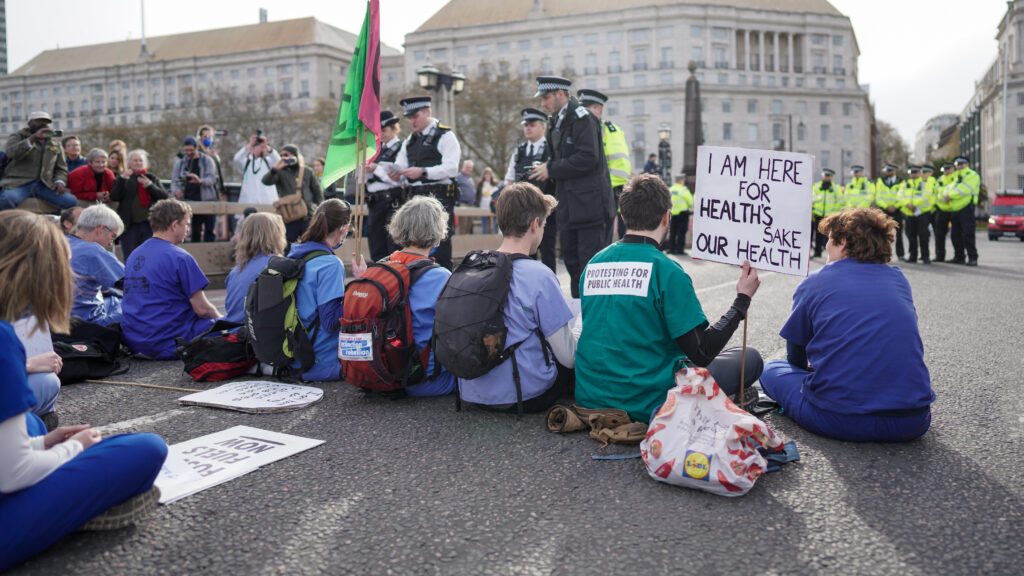
Bonn, 17 June 2026:– Civil society organisations have called for a dramatic increase to public, grant-based adaptation finance during a press conference held during the annual Bonn climate conference (SB 64).
“Clearly, governments must agree to triple public, grant-based adaptation finance to at least USD 120 billion by 2035”, said Jess Beagley, Policy Lead at the Global Climate and Health Alliance. “Without adaptation finance, life saving action to build resilience in the health sector and in health determining sectors, such as water and sanitation, disaster planning, and food systems, will be impossible – risking malnutrition, waterborne disease, exposure to extreme weather, and lack of access to health services at the very moments they are most needed.”
“The communities we work with are not experiencing climate change as an environmental issue — they are experiencing it as a health crisis that moves through every dimension of their lives”, said Niona Nakuya Kasekende, Programs Manager at Regenerate Africa. “The evidence is not the problem. We have documented it, published it, and brought it into these rooms. What vulnerable communities need now is finance — public, grant-based, gender-responsive adaptation finance that reaches the sectors determining whether women and girls survive climate change: their food, their water, their homes, their roads, and the health facilities that cannot function without any of these. Tripling adaptation finance to USD 120 billion by 2035 is the floor, not the ceiling. And the quality of that finance matters as much as the quantity — because more debt for the world’s most climate-vulnerable countries is not adaptation. It is a different kind of crisis.”
“Failing to provide adaptation finance is a denial of human rights, particularly to women, girls, and gender-diverse people, as the ever-escalating impacts of climate change affect their right to health, including sexual and reproductive health and rights”, said Tara Daniel, Associate Director of Policy, Women’s Environment and Development Organization (WEDO). “In this first year of implementation of the Belém Gender Action Plan, which recognizes health, violence against women, and care as relevant issues, we call on Parties to resolve the inherent dissonance in promoting gender-responsive climate action yet not committing to provide adaptation finance, including to the perennially-underfunded Adaptation Fund. Upholding global mandates on health, human rights, and gender equality requires drastically scaling up climate finance in fulfillment of the New Collective Quantified Goal, as a necessary first step toward a world where climate chaos doesn’t destroy the possibility for living a full and healthy life.”
“There is no public health protection without adaptation finance”, said Pooja Dave, Policy Coordinator at Climate Action Network. “Every delay in delivering adaptation finance means more preventable deaths from heat, more disease outbreaks after floods, and more communities left exposed to climate risks. “The adaptation finance gap is not measured only in dollars – it is measured in lives lost. If we are serious about protecting people, the commitment to triple adaptation finance must move from promise to delivery.”
About the press conference:
Adaptation finance falls dangerously short of the levels needed – UNEP projects that by 2035, the level of adaptation finance required in developing countries will reach US$ 310-365 billion annually. Yet, adaptation finance fell from US$28 in 2022 to US$26 in 2023 (UNEP, 2025). At COP30, Parties committed to triple adaptation finance by 2035.
Adaptation finance across sectors is a lifeline – without it, populations will be left without access to nutritious food, potable water, safe homes, clean and reliable energy, or basic healthcare services. The quality of adaptation finance is also a vital issue, including delivery to communities and avoiding reinforcing cycles of debt, poverty and disease: the poorest countries in the world currently spend more on debt service than on healthcare, education and infrastructure combined (Bridgetown Initiative, 2024).
Well-designed adaptation interventions which protect health and lives offer high returns on investment. Health itself is also a pillar of adaptation, with healthy communities being the most resilient to climate shocks.
ENDS
Press Contact:
Dave Walsh, Communications Advisor, Global Climate and Health Alliance, [email protected], +34 691 826 764 (Available from 0630 CET)
About GCHA
The Global Climate and Health Alliance is a consortium of more than 250 health professional and health civil society organisations and networks from around the world addressing climate change. We are united by a shared vision of an equitable, sustainable future, in which the health impacts of climate change are minimised, and the health co-benefits of climate change mitigation are maximised.
Find out more: https://climateandhealthalliance.org/who-we-are/about/