Global, 22 July 2026:- Following July’s NATO summit, and with hostilities resuming in the US-Iran war after a 60-day ceasefire, a new report from the Global Climate and Health Alliance highlights the deep interlinkages between climate change and armed conflict, and how the intersection of these issues become mutually reinforcing drivers of harm to human health.
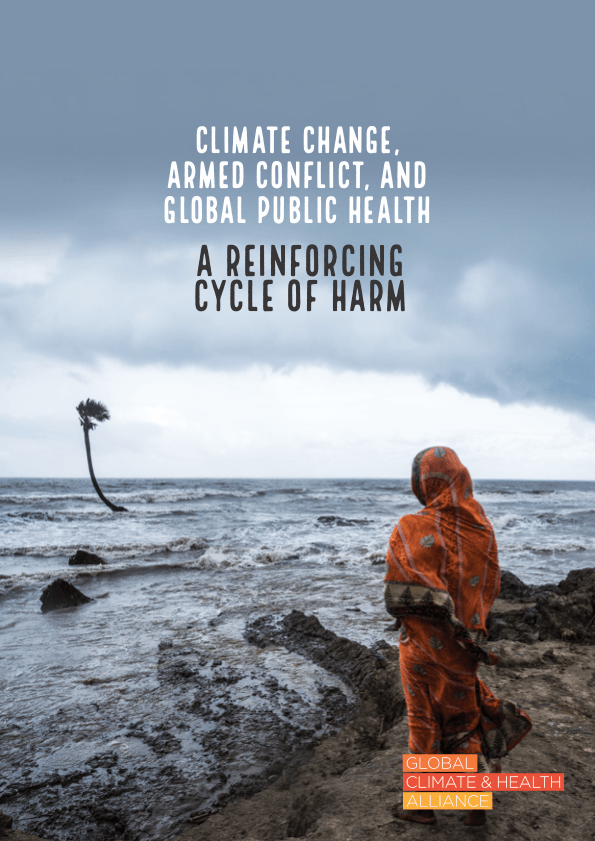
The report, Climate Change, Armed Conflict, and Global Public Health: A Reinforcing Cycle of Harm presents current evidence on the relationship between climate change and armed conflict, and its implications for global public health. The report finds that each such crisis does not occur in isolation but rather they converge in a polycrisis, a condition in which multiple global crises such as climate change, armed conflict, economic instability, under-resourced health systems, and an evolving digital landscape interact and amplify one another, generating a significant threat to global public health.
“This report shows that from wildfires to wars, trying to address each of the elements of the polycrisis in isolation will impact the health of everyone, with the world’s most vulnerable people worst affected”, said Dr Courtney Howard, Board Chair of the Global Climate and Health Alliance, a consortium of more than 200 health professional and health civil society organisations and networks from around the world addressing climate change.
“Increasing instability in Earth’s climate, oceans and biodiversity will continue to act as a threat multiplier, threatening human security worldwide”, continued Howard. “To pull out of this worsening climate-conflict spiral, humanity must shift from reacting to individual crises to systematically investing in strengthening the ecological, social, and institutional foundations of wellbeing. This can create reinforcing feedback that improves health, resilience, and peace together, as envisioned in the Paris Agreement and the Pact for the Future.”
“The report shows us that governments and international financial actors must respond to climate change with increased investment in climate adaptation, the building of resilient health systems – including renewable-powered healthcare facilities – and by ensuring capabilities for strong humanitarian responses”, said Dr Howard.
“The Global Climate and Health Alliance is calling on governments to recognise that redirecting investments away from climate change and health and into the military will not in itself deliver security – it is essential they make greater sustainable investment in climate-resilient communities and health systems, universal access to clean energy, stronger multilateral cooperation, and adherence to international humanitarian law”, added Jeni Miller, Executive Director of the Global Climate and Health Alliance. “By investing in climate mitigation and adaptation we can reduce the stressors that exacerbate conflict, build resilient health systems, communities and economies, and ensure that robust humanitarian responses are part and parcel of securing a peaceful future”.
Climate change is a threat multiplier that threatens people’s access to life essentials including food, water, livelihood, and energy. It causes migration and forced displacement, creating tensions that can exacerbate armed conflict. Armed conflict in turn drives people from their homes and disrupts or destroys life necessities, while doing major environmental harm – a devastating cycle that has severe implications for global public health.
The report highlights that the intersecting and compounding interplay between climate change and armed conflict have devastating effects in conflict zones themselves, while often also having repercussions across neighboring countries, whole regions, or even internationally. These range from the effects of conflict- and climate change-driven migration, to impacts on the availability of resources as acutely demonstrated by the current US-Iran war and its global effects on fuel prices, food prices, and more. For populations already in vulnerable circumstances, those vulnerabilities are severely worsened, with refugees and asylum seekers, women and girls, children, older adults, remote and rural communities, and Indigenous communities bearing a disproportionate burden of this convergence.
“Healthcare professionals provide on-the-ground care in conflict and humanitarian settings, where their safety should be sacrosanct”, said Dr Omnia El Omrani, Global Climate and Health Alliance Vice Chair and former UNFCCC Youth Envoy. “They are also well positioned to speak to the health impacts of climate change, violence and human rights violations, through education, evidence-based advocacy, and engaging with decisionmakers and policy processes. Doctors know firsthand the strain that climate change puts on communities, how climate change compounds other threats, and the myriad direct and indirect ways that armed conflict devastates communities’ health and safety.”
“Every government must ensure the protection of healthcare personnel, and health and critical infrastructure in every conflict setting, and it is unacceptable that these protections are increasingly being violated”, added Howard. “In addition, governments must provide greater accountability for greenhouse gas emissions from military activities, so that we know the extent to which military action is putting both our present and our future at risk”.
“World leaders and policymakers should heed the warnings in this report – only an integrated approach that continues to advance climate action, invests in people’s health and well being, and pursues peacebuilding over aggression will deliver true security”, concluded Miller.
ENDS
Contact:
Dave Walsh, Communications Advisor, Global Climate and Health Alliance, [email protected], +34 691 826 764 (Available from 0630 CET)
About GCHA
The Global Climate and Health Alliance is a consortium of more than 250 health professional and health civil society organisations and networks from around the world addressing climate change. We are united by a shared vision of an equitable, sustainable future, in which the health impacts of climate change are minimised, and the health co-benefits of climate change mitigation are maximised.
Find out more: https://climateandhealthalliance.org/who-we-are/about/