 |
 |
- Join launch event online – or in person (Geneva) 14 October 1830 CEST – see your timezone here
- Healthy NDC Scorecard website
- Download Healthy NDC Scorecard barchart
- Download Healthy NDC Report
- Download all of the Healthy NDC Country Scorecards
- Download country-specific quotes
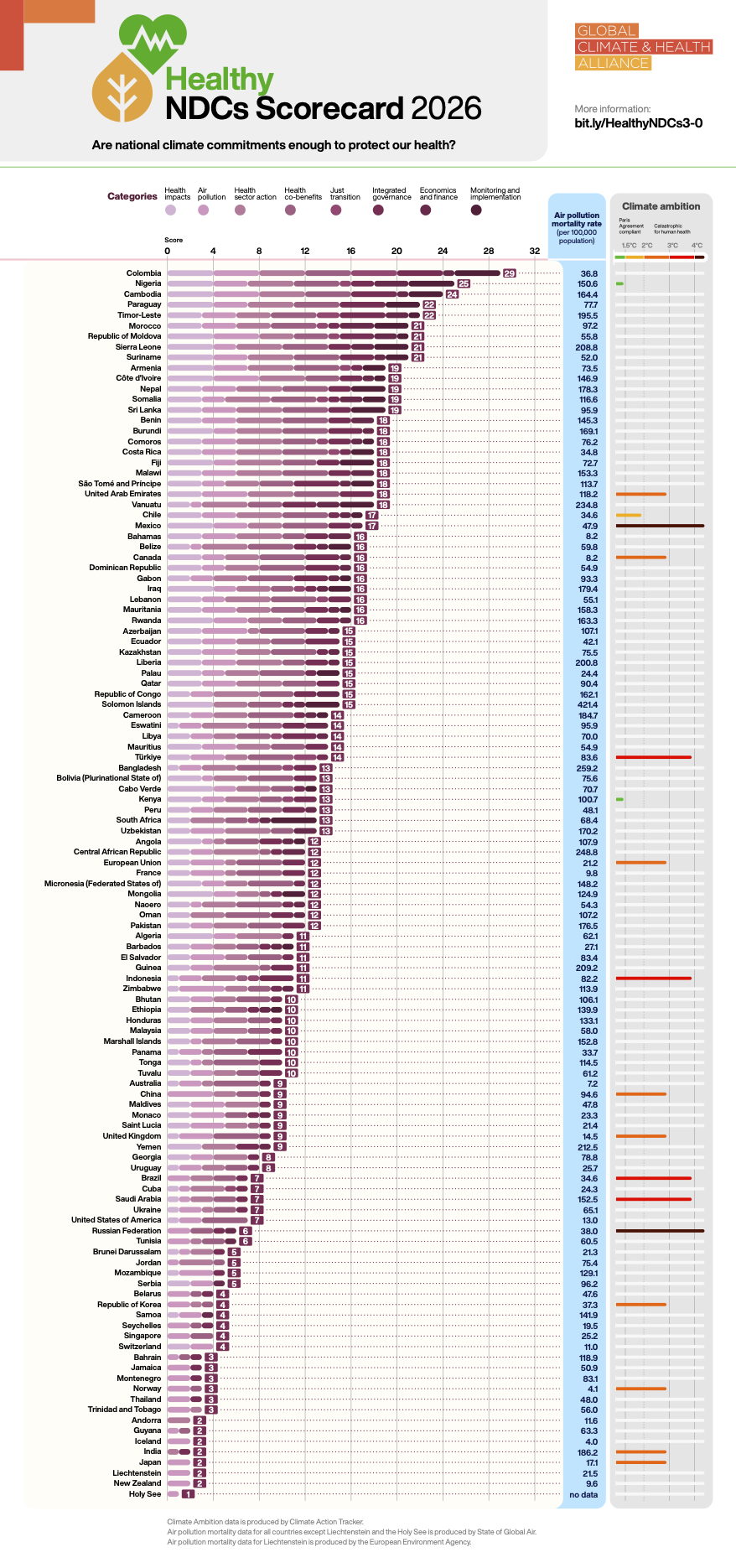
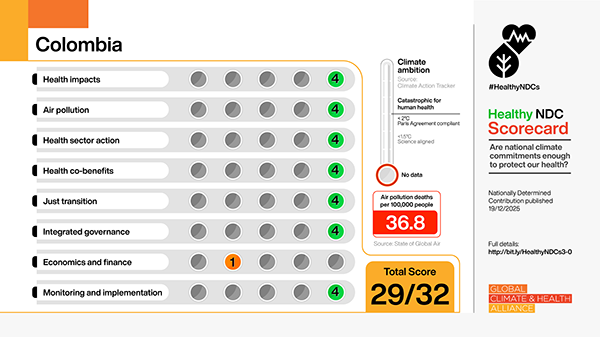
Global, 14 October 2026:- Colombia integrates health most deeply into its national climate plan, according to a new global scorecard published today, closely followed by Nigeria and Cambodia.
The latest Healthy NDC Scorecard, published by the Global Climate and Health Alliance finds that conversely, the climate commitments of the governments of Japan, New Zealand and India fail to adequately consider health, while high-emitting economies, including EU members, China, Brazil, and the UK refer to health in their national climate plans, but do not match this with the ambitious emissions reductions targets required to protect health.
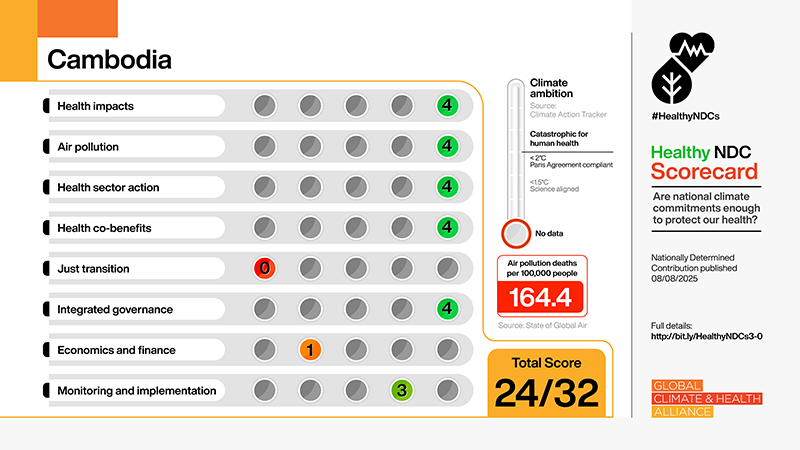
The research by the Global Climate and Health Alliance, a consortium of more than 300 health professional and health civil society organisations and networks from around the world addressing climate change, also finds that many countries are missing opportunities to simultaneously improve air quality, protect public health, and address climate change, with only five countries (Cambodia, Chile, Colombia, Costa Rica, and Paraguay) setting targets to reduce black carbon, a major driver of global heating and air pollution which contributes to severe health harms.
“The Healthy NDC Scorecard enables us to evaluate how governments are considering health in their climate planning, whether this is matched by their emissions reductions ambition, and to compare intended health and climate action to actual national air pollution mortality”, said Dr Nova Tebbe, Post Doctoral Researcher at the Global Climate and Health Alliance and research lead of the study.
“The human face of climate change has never been more obvious – governments must act now to integrate health”, added Tebbe. “Rapid action to address short-lived climate pollutants including black carbon, methane, HFCs and tropospheric ozone offers a triple win of slowing the pace of global heating and future health threats, additional near-immediate health gains, and significant cost savings even within a political term. At the same time, more ambitious action is required to dramatically reduce emissions of CO2 is critical in order to limit warming to levels compatible with human health for decades to come”.
“Clearly, such action must be taken immediately, and implemented rapidly – health impacts of climate change are intensifying, with even further escalation probable due to El Niño conditions”, added Tebbe. “In the past months, floods have killed hundreds of people in Nepal, millions of children are at risk of hunger in Eastern and Southern Africa, Europe and the United States have seen widespread heat-related mortality and hundreds of wildfires have raged in Canada.”
“Governments must grasp that air quality action is a vital part of effective climate action, and that people’s health and lives are at stake with both”, said Dr Jeni Miller, Executive Director of the Global Climate and Health Alliance. “Ensuring the integration of health and air quality considerations into climate policy protects populations, maximises economic benefits, and builds public backing for ambitious climate policies which are so urgently needed. Integrating health into climate policies across sectors is essential to reaping these benefits, and to protecting people’s health and well being in the climate era. Omitting them represents a missed opportunity for climate change, air quality, and protecting people’s lives.”
The NDC Scorecard provides policymakers with the means to identify strengths, gaps, and opportunities within climate plans by highlighting where health and clean air considerations are being addressed—and where more action is needed. The Scorecard also showcases good practices from around the world to protect health and reduce air pollution, and enables countries to compare their progress with others. The Global Climate and Health Alliance previously produced healthy NDC Scorecards in 2021 and 2023, followed by a Clean Air Scorecard in 2023.
Scorecard Results
The Scorecard demonstrates the extent to which governments’ national climate commitments (Nationally Determined Contributions, NDCs) recognise the links between climate change, air quality and the health of their populations, and whether they define plans for taking action. The Scorecard assesses the plans of 132 countries which submitted their 2035 climate plans to the United Nations Framework Convention on Climate Change (UNFCCC) in accordance with the Paris Agreement, in advance of 1st August 2026, including the joint plan submitted by EU members.
At the top end of the NDC Scorecard, Colombia scores 29 from a possible 32 points, followed by Nigeria at 25 and Cambodia with 24. Paraguay and Timor-Leste received 22, rounding out the top five countries creating policies that, if fully implemented, would greatly contribute to protecting their citizens from climate change. Notably, 19 of the top 20 scores are secured by low- and middle-income countries (LMICs).
Japan, India and New Zealand are among the lowest scoring countries, achieving just two points each, indicating a lack of recognition of the links between climate change and human health. The emission reduction targets of Japan and India have been assessed by Climate Action Tracker and are not aligned with the Paris Agreement, with grave risks to human health, and potentially leaving citizens unprotected due to inadequate planning to protect health. India additionally carries a high burden of air pollution mortality; but is among the countries which do not refer to air pollution considerations in their NDCs.
Other high-emitting countries also fall short of ten points, having failed to commit to their fair share of emissions reductions – namely the Republic of Korea (four points out of 32), Russia (six points), Brazil (seven points), and Australia, China and the UK (nine points).
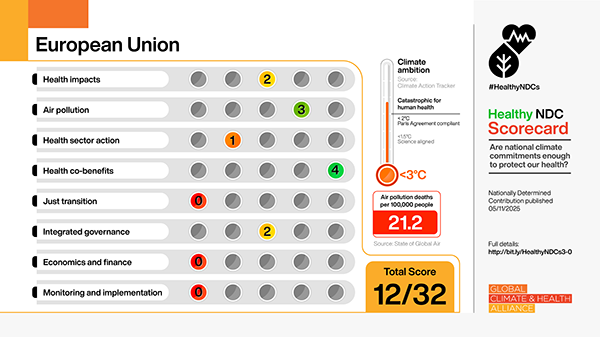
While Indonesia (11), the EU (12), South Africa (13), Türkiye (14) Canada (16) and the UAE (19) score higher for health, this is not matched by ambitious emissions reductions targets, risking worsening health impacts over time. Notably, of these high emitters with mid-range attention to health, the EU’s NDC is the only one which outlines a specific target for air pollution reduction; specifically, to fully phase out hydrofluorocarbons (HFCs) by 2050. None of this group of countries include targets for black carbon, nitrous oxide or ozone, which are among other major “superpollutants” especially harmful to the climate and human health. These pollutants drive global heating more rapidly than carbon dioxide, compounding the health harms of climate change, and also harm human health through air pollution. The NDC of the United States was also analysed, but is not currently active following the US’s withdrawal from the Paris Agreement. The Scorecard allots the US NDC a relatively low health score of seven, while national climate policies were additionally assessed as “highly insufficient” or “critically insufficient” to deliver the Paris Agreement.
Among the countries ranked highest for their attention to health, Nigeria also demonstrates extremely high levels of climate ambition, fully in line with its fair share of emissions reductions to curb global heating and prevent intensifying harms to human health. Meanwhile, the Republic of Moldova places great emphasis on air pollution, with a National Short-Lived Climate Pollutants Plan under development, while Nigeria and Paraguay each already have one in place. All three countries clearly refer to the health co-benefit opportunities of these plans.
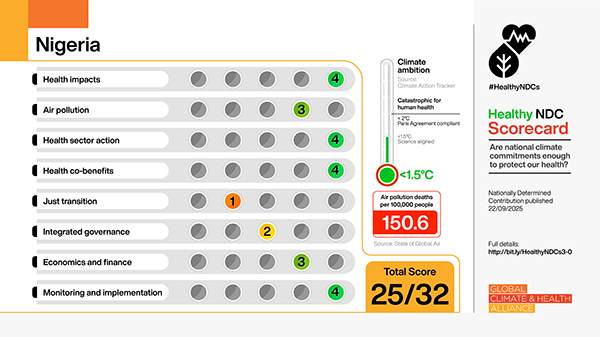
Data on air pollution mortality similarly underscores the need for finance to bridge commitment and implementation: Nigeria and Nepal include attention to air pollutants but continue to face exceptionally high rates of air pollution mortality. Meanwhile, the latest State of Global Air Quality Funding report reveals that outdoor air quality funding still received less than 1% of development funding, despite the fact that 5% of global GDP is lost to air pollution through health impacts, lost productivity, and reduced life expectancy.
“Often, health is considered to primarily be an issue associated with adaptation considerations, and indeed adaptation is vital, especially in countries already facing climate impacts”, said Tola Klabough, Project Analyst. “But by failing to also consider the links between health, emissions reductions, and co-benefits such as air quality improvements, governments not only miss out on returns on investment but risk charting a course to a world where health systems are overwhelmed by the compounding health burden of air pollution and increasingly severe climate hazards, exceeding the limits of adaptation, and with spiralling costs.”
“The fact that the highest scores go to countries in the Global South reflects lived realities – these countries do not have the luxury of pretending that climate change and health can be separated. Nevertheless, NDCs are plans, and require finance to be implemented”, said Jess Beagley, Policy Lead with the Global Climate and Health Alliance. “In developing countries a significant proportion of the finance for NDC implementation needs to come from developed countries, in line with Article 9.1 of the Paris Agreement. Such funding is quite literally a lifeline. High historical and present emitters also have a responsibility to reduce their emissions fastest. In particular, the reduction of short-lived climate pollutants is urgently needed to ensure that 1.5C overshoot remains temporary, minimising harm to human health.”
“With the majority of countries now having submitted their NDCs 3.0, COP31 will provide an opportunity to elevate national priorities to global decisionmaking. One key consideration in this regard will of course be finance”, said Beagley. “A new agenda item on a climate finance work programme has been proposed by Brazil, with expectations that this will focus on the obligations of developed countries under the Paris Agreement to provide developing countries with climate finance. Without finance to enable lifesaving adaptation across sectors, the burden on the healthcare sector will be overwhelming.”
“In addition, COP31 marks the start of the second global stocktake, which offers opportunities to translate national advances into global policies,” said Beagley. “To date, the global stocktake has been the only UNFCCC item to specifically include a call for a just transition away from fossil fuels in a negotiated text – avoiding backsliding on this previously agreed call is a public health imperative.”
About the Scoring System
Using a qualitative coding and point-based methodology, the Scorecard evaluates the inclusion of health in NDCs across eight key categories and then compares this to available data on emissions reduction ambition and air pollution mortality. The eight categories, for each of which there are up to four points available, are:
- Health impacts: The health impacts of climate change and air pollution, whether quantified or qualitatively described.
- Air pollution: Points are awarded for named air pollutants, general air pollution, and setting air quality targets.
- Health sector action: Policies for adaptation in the healthcare sector, to ensure more resilient healthcare provision, with one point available for countries also specifying mitigation in the healthcare sector.
- Health co-benefits: Mitigation and adaptation actions in sectors other than the healthcare sector which are recognised in the NDC to offer benefits for health.
- Just transition: References to just transitions in relation to health, and mentions of worker health, vulnerable populations, and the healthcare sector in this context.
- Integrated governance: Collaboration with the Ministry of health, efforts to mainstream health into climate decisionmaking, or recognition of the human right to health or the right to a clean, healthy and sustainable environment.
- Economics and finance: Costs of climate impacts, and also costs of specific actions, budgetary allocations and returns on investment from health related actions across sectors.
- Monitoring and implementation: Monitoring implementation of health related actions within and beyond the health sectors, as well as the health outcomes of any such actions.
ENDS
Contact:
Dave Walsh, Communications Advisor, Global Climate and Health Alliance, [email protected], +34 691 826 764 (Available from 0630 CET)
About GCHA
The Global Climate and Health Alliance is a consortium of more than 300 health professional and health civil society organisations and networks from around the world addressing climate change. We are united by a shared vision of an equitable, sustainable future, in which the health impacts of climate change are minimised, and the health co-benefits of climate change mitigation are maximised.
Find out more: https://climateandhealthalliance.org/who-we-are/about/