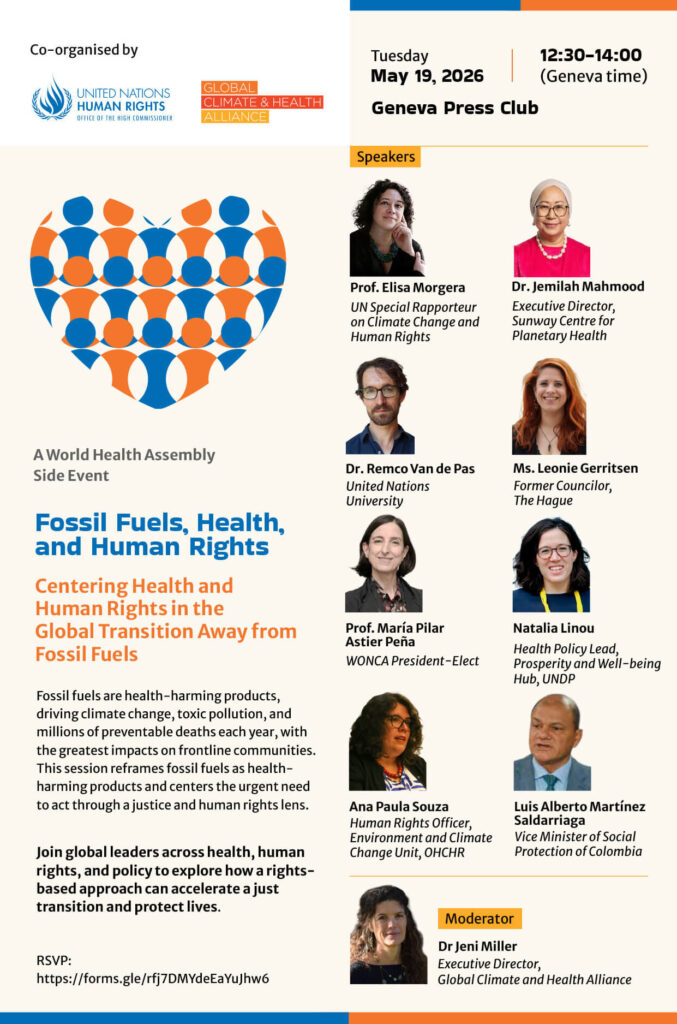
What: Fossil Fuels, Health, and Human Rights – Centering Health and Human Rights in the Global Transition Away from Fossil Fuels
When: 12:30-14:00 CEST, 19 May 2026
Where: Geneva Press Club, Domaine de Penthes, Chemin de l’Impératrice 18, 1292 Pregny-Chambésy / Geneva (map)
Who: Global Climate and Health Alliance will co-host, with the Office of the United Nations High Commissioner for Human Rights (OHCHR)
How:
On May 19th, the Global Climate and Health Alliance and the Office of the United Nations High Commissioner for Human Rights (OHCHR) will co-host Fossil Fuels, Health, and Human Rights – Centering Health and Human Rights in the Global Transition Away from Fossil Fuels at the Geneva Press Club.
This side event at the World Health Assembly will gather top experts from human rights, health, and government to discuss how using a human rights-based approach can speed up the move away from fossil fuels, protect health, and promote fairness around the world.
Speakers
- Prof Elisa Morgera, UN Special Rapporteur on Climate Change and Human Rights (video)
- Dr Jemilah Mahmood, Executive Director, Sunway Centre for Planetary Health (video)
- Ana Paula Souza, Human Rights Officer, Environment and Climate Change Unit, OHCHR
- Natalia Linou, Health Policy Lead, Prosperity and Well-being Hub, UNDP
- Dr. Remco Van de Pas, United Nations University
- Ms. Leonie Gerritsen, Former Councillor, The Hague
- Prof. María Pilar Astier Peña, WONCA President-Elect
- Luis Alberto Martínez Saldarriaga, Vice Minister of Social Protection, Colombia
Moderator
Dr Jeni Miller, Executive Director, Global Climate and Health Alliance
Background
Fossil fuels are the main cause of the linked crises of climate change, pollution, and biodiversity loss. Throughout their entire lifecycle, from extraction to burning and waste, they seriously harm both human health and the environment.
Air pollution, mostly caused by burning fossil fuels, leads to about 8 million early deaths each year. This makes it one of the biggest environmental health risks worldwide. In addition to air pollution, extracting and producing fossil fuels exposes people to toxins, pollutes water, creates workplace dangers, and forces some communities to move. These harms often hit marginalized and frontline groups the hardest.
The Global Climate and Health Alliance’s report, Cradle to Grave: The Health Toll of Fossil Fuels details the many health problems linked to fossil fuels at every stage, from exploration and extraction to transport, refining, burning, and waste. The report shows that fossil fuels are not just an energy issue—they are a major public health threat. They cause a wide range of health problems, including breathing and heart diseases, cancers, reproductive issues, mental health stress, and emergencies related to climate change.
Even with this evidence, fossil fuels are still mostly seen as an economic or energy policy issue. The real health costs, which are paid by people, communities, and health systems, are often overlooked in policy decisions.
More international laws and policies increasingly underscore the need to address fossil fuels through a human rights lens. The recognition of the right to a clean, healthy, and sustainable environment, alongside recent findings from UN Special Rapporteurs and the International Court of Justice Advisory Opinion, makes it clear that states have an obligation to prevent environmental harm arising from fossil fuels that threatens fundamental rights, including the rights to life, health, water, food, and a healthy environment.
Health experts are starting to see that we need to treat fossil fuels as products and materials that harm health, similar to how public health has dealt with tobacco and other dangerous industries.
Recent political developments, such as the results of the Santa Marta Conference on transitioning away from fossil fuels, the Brazil-led proposal for a roadmap on phasing out fossil fuels under the UNFCCC, UNGA Resolution on the operationalization of the ICJ AO; and new talks about a World Health Assembly declaration on fossil fuels and health, show a growing recognition that fossil fuels are a key public health issue.
Meanwhile, the real experiences of communities in the Global South, from living near toxic industrial areas to facing disasters made worse by climate change, show the urgent need for policies based on fairness, justice, and human rights.
Contact:
Dave Walsh, Communications Advisor, Global Climate and Health Alliance, [email protected], +34 691 826 764 (Available from 0630 CET)
About GCHA
The Global Climate and Health Alliance is a consortium of more than 250 health professional and health civil society organisations and networks from around the world addressing climate change. We are united by a shared vision of an equitable, sustainable future, in which the health impacts of climate change are minimised, and the health co-benefits of climate change mitigation are maximised.
Find out more: https://climateandhealthalliance.org/who-we-are/about/