79th World Health Assembly
Find out more about the 2026 World Health Assembly and what it meant for the climate and health movement.
World Health Assembly: © WHO / Pierre Albouy
The 79th World health Assembly (WHA 79) took place 18-23 May 2026 in Geneva, Switzerland. Learn more about the outcomes for the climate and health movement.
How and where did climate change feature at WHA79?
WHA was an important moment for the global climate and health community to reiterate the far-reaching and widespread impacts of the climate crisis and fossil fuels on human health and wellbeing.
While climate and health was not a specific issue on the agenda of WHA79, eight agenda items touched on climate-related issues- including mental health, non-communicable diseases, antimicrobial resistance, and maternal, infant and young child nutrition- however it was missing from several key discussion items. GCHA noted the omission of climate from discussions on global health architecture reform during the meeting.
While not on the official agenda of WHA 79, a number of side events on the margins of the assembly highlighted fossil fuels as the primary driver of climate change, and responsible for a wide range of other significant health harms globally.
Following WHA79 GCHA urges governments and WHO to integrate climate change considerations into and across all areas of global health planning, programs and policy, and to recognize the profound health harming impacts of the primary driver of climate change, fossil fuels. See more here.
What is the World Health Assembly?
The World Health Assembly (WHA) is the annual meeting of the world’s ministries of health, hosted and convened by the World Health Organization (WHO) to set global health policy. Delegates make decisions on health targets, financing and strategies that will guide their own public health work.
In regard to climate change, it is an opportunity to ensure that the health impacts of the climate crisis and climate action are discussed and acted upon at the highest level of global health decision making.
A brief history of climate change discussions at the World Health Assembly
Climate change as a global health threat was first recognised formally at the 61st World Health Assembly (WHA) in 2008, with the adoption of a resolution on climate change and health.
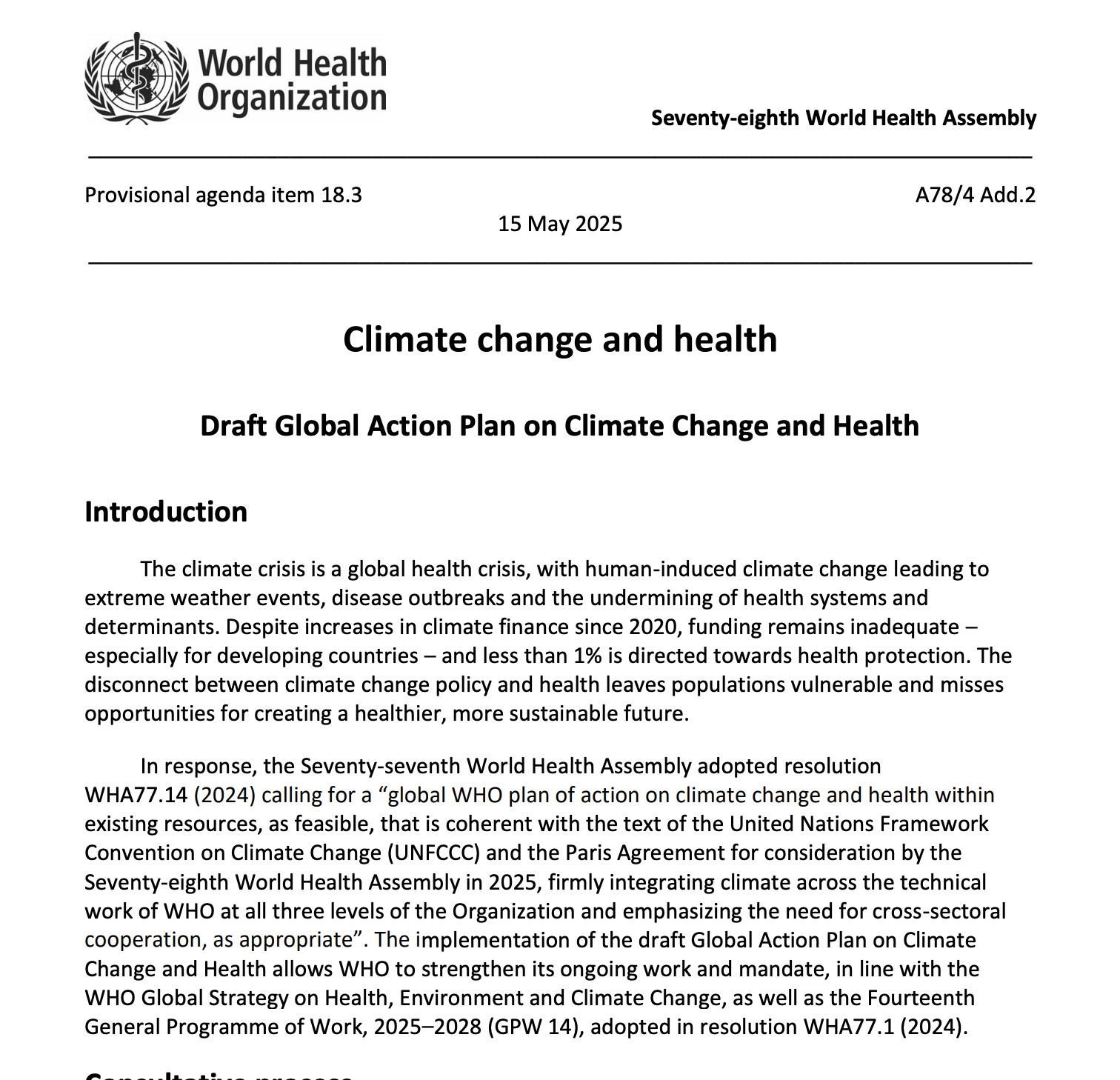
Since 2008, climate change has increasingly been recognised as a fundamental threat to the health of people and health systems, most recently with the adoption of a second dedicated resolution on climate change and health at the 77th WHA in 2024, and an accompanying Global Action Plan (GAP) the following year, at the 78th World Health Assembly (WHA78), held in May 2025. This GAP marked a milestone in global health and climate action as the plan set out concrete steps for governments and the WHO to address the health impacts of climate change.
The GCHA and its members welcomed the GAP as a much-needed tool to drive action, particularly its strong emphasis on integrating health into countries’ climate commitments (NDCs) and embedding climate into national health plans. However, we were alarmed at the omission of any reference to a just transition away from fossil fuels, or fossil fuel subsidy reform, in the GAP, because of the role fossil fuels play in driving both climate change and air pollution, and the myriad other means of health harms.
Responding to climate change is also the first strategic objective of WHO’s 2025-2028 Global Health Strategy and Fourteenth General Programme of Work.
Useful resources