Global, 26 October 2026:- Health and civil society organisations today called on WHO member states to recognise climate disinformation as a public health threat and make information integrity a core part of climate and health policy, preparedness and response.
The call comes as concern about the integrity of the global information environment moves rapidly up the international agenda. The United Nations has established Global Principles for Information Integrity; Brazil, the UN and UNESCO have launched the Global Initiative for Information Integrity on Climate Change; and at COP30 in Belém in 2025, information integrity was formally recognised as essential for effective climate action.
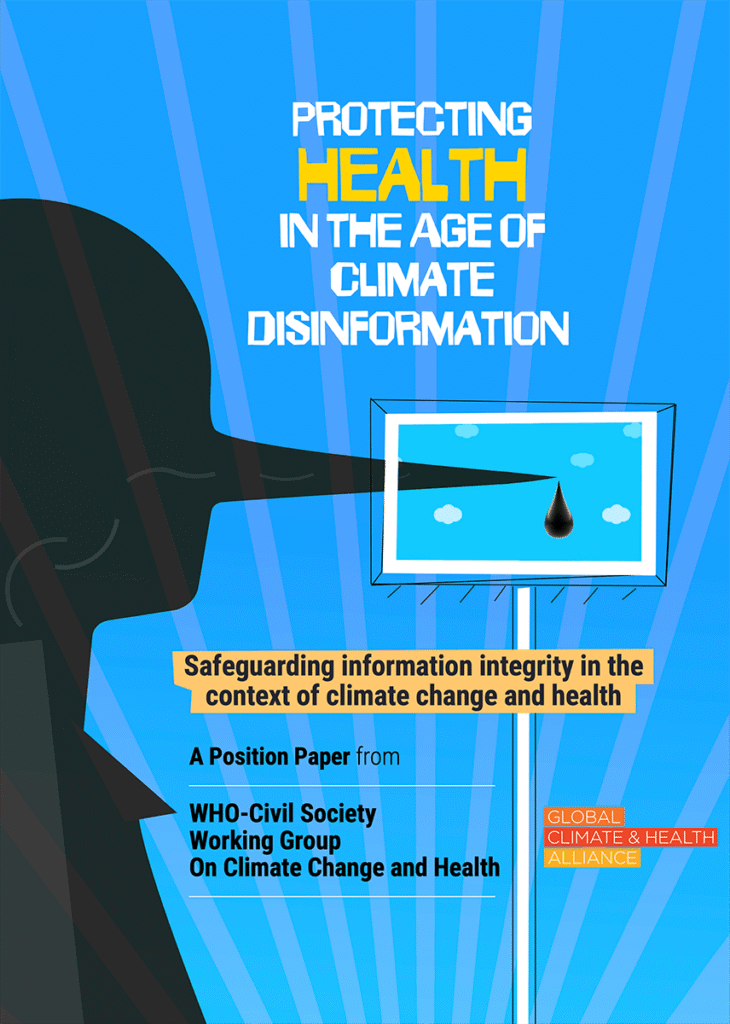
Now the health community is calling for that recognition to extend to public health: a new report, Protecting Health in the Age of Climate Disinformation, produced by the WHO Civil Society Working Group on Climate and Health states that “a healthier information environment is not a communications luxury. It is a condition for climate justice, public health, and the right to a healthy future.”
The report is the first instance of the health community addressing how climate disinformation directly and indirectly harms human health around the world, from undermining emergency warnings and public-health guidance to delaying policies on air pollution, clean energy and fossil fuels.
Case studies highlighted in the report show that climate disinformation interacts with existing inequalities and power structures. The case studies include wildfire misinformation in Canada and Maui, backlash against London’s Ultra Low Emission Zone, cascading climate and information risks during floods in South Sudan, fossil fuel greenwashing, development narratives affecting Indigenous Peoples in Indonesia, and attacks on scientists, journalists and environmental defenders. Those trying to provide evidence can also become targets.
The report argues that the climate crisis now demands the same level of institutional seriousness that public health has brought to other major information threats. It calls for information integrity to be embedded across climate and health policy, rather than treated as the responsibility of communications teams alone. It also urges stronger climate and health education that clearly links fossil fuel combustion, air pollution, harmful exposures, disease and climate change, so that health professionals are equipped to communicate not only the health consequences of the climate crisis, but also its underlying drivers.
Protecting Health in the Age of Climate Disinformation highlights the interests and power structures that enable disinformation to flourish, including fossil fuel greenwashing and conflicts of interest, and sets out what WHO, governments, health institutions and civil society can do to strengthen the integrity of the information environment.
“In this moment of turbulent geopolitics and global uncertainty, where vested interests are clearly backing climate denialism and delay, WHO member states governments must strive to provide clear, timely, evidence-based information that empowers people to protect their health against both a warming climate, and disinformation aimed at sowing doubt and confusion”, said Dr Jeni Miller, Executive Director of the Global Climate and Health Alliance, and co-chair of the WHO Civil Society Working Group on Climate and Health. “Governments must integrate tools for mis- and disinformation response into how they prepare and communicate heat, wildfire, flood, storm, drought, and infectious disease scenarios.
“Climate disinformation is not only a problem of false rumours and mistruths; it is also a problem of power, incentives and accountability”, added Miller. “WHO, its member states, health institutions and the health community must go beyond simply providing better information and messaging – they must establish robust conflict-of-interest safeguards against fossil fuel greenwashing, and against those who wield climate disinformation as a hybrid weapon of war.”
“Climate disinformation is not merely a challenge for climate scientists or communications teams”, said Dr Diarmid Campbell-Lendrum, Head of Climate Change, Energy, and Air Quality Unit at WHO. “It is a public health threat that weakens trust, increases exposure to preventable risks, and delays progress towards a future powered by clean, cheap, renewable energy – that would bring huge health gains. The health community has a responsibility to respond.”
“The health impacts can be immediate – misleading information can for example discourage people from evacuating during wildfires or floods, undermine confidence in heat and air-pollution warnings, interfere with access to disaster assistance, and create confusion about health risks during emergencies. But the consequences also extend far beyond individual emergencies” said Dr Laura Jung, Chair of the Working Group on Environment, World Medical Association. “This report calls for information integrity to become part of the core architecture of climate and health policy and calls on the World Health Organization (WHO) and the member states to collectively recognise climate disinformation as a public health threat and develop guidance on managing the climate-health infodemic.”
“Climate action and information integrity are two sides of the same coin – a healthy information environment should not be considered a lateral issue, but a right that is central to protecting our health”, said Guilherme Canela, one of the architects of the Global Initiative for Information Integrity on Climate Change. “To ensure people’s health is protected from the climate crisis means they must be able to gain access to accurate and reliable information and trust evidence, and make informed decisions for their families while holding national policies that safeguard their health accountable. The Belém Declaration on Information Integrity on Climate Change offers a comprehensive framework, which is relevant for the climate information ecosystem and for broader discussions, such as the ones related to health.”
“Public health starts with protecting people from the conditions that make them sick. Climate disinformation undermines that work by obscuring the health harms of fossil fuels and weakening support for the policies that could prevent them,”said Dana Schran, Coordinator of Climate Action Against Disinformation.
“This is why health institutions must not only protect the integrity of the information on which public decisions depend, but also examine how they procure communications services”, said Schran. “Working with PR and advertising agencies that also represent fossil fuel interests can create serious conflicts of interest and undermine public trust. Ensuring that communications contracts are fossil-fuel-free and free from such conflicts should be part of responsible health-sector practice.”
Andre“Scientists, health professionals, journalists, indigenous leaders and environmental defenders who communicate evidence may face harassment, legal pressure, gender-based abuse and, in some contexts, threats to their safety,” said Dr. Jose Félix Hoyo Jiménez of Medecins du Monde. “Protecting information integrity also means protecting the health and well-being of people and communities, and recognising the role that trustworthy information plays in safeguarding both.”
The report argues that the health sector is not starting from zero.
“Decades of tobacco control have shown how commercial interests can manufacture doubt, distort the evidence and undermine health policy. The COVID-19 pandemic exposed how rapidly mis- and disinformation can overwhelm institutions, fuel confusion and erode public trust. Vaccine-confidence programs have reinforced another critical lesson: facts alone are not enough; trust is built through credible voices, meaningful relationships and sustained engagement,” said Prof. Ruth Etzel, of International Pediatric Association.
“The experience in emergency risk communication has demonstrated that timely, clear and credible information can save lives. We have an opportunity to take what public health has learned from tobacco, vaccines, infectious disease outbreaks and emergency risk communication and apply it to the climate crisis, one of the defining health threats of our time,” added Etzel
The report argues that the climate crisis now demands the same level of institutional seriousness that public health has brought to other major information threats. It calls for information integrity to be embedded across climate and health policy, rather than treated as the responsibility of communications teams alone. It also urges stronger climate and health education that clearly links fossil fuel combustion, air pollution, harmful exposures, disease and climate change, so that health professionals are equipped to communicate not only the health consequences of the climate crisis, but also its underlying drivers.
Other conclusions from Protecting Health in the Age of Climate Disinformation:
- Governments should integrate misinformation and disinformation preparedness into climate-related emergency response, strengthen climate and health literacy, regulate greenwashing and protect policy from conflicts of interest, and ensure people have timely access to trustworthy information during heatwaves, wildfires, floods, storms, droughts and disease outbreaks.
- WHO and health agencies should recognise climate disinformation as a health risk, strengthen climate-health infodemic management and help countries develop the capacity to identify and respond to harmful information narratives.
- Health professional associations and health civil society should train and protect their members, refuse fossil fuel-linked sponsorship and strengthen climate-health education. Health civil society should document disinformation, support communities and build alliances across health, climate, journalism, labour, Indigenous Peoples and environmental justice movements.
- Funders should invest in research, local-language journalism, community-led evidence, rapid-response capacity and protection for targeted messengers, particularly in low- and middle-income countries.
Established in 2019 by WHO Director-General Tedros Adhanom Ghebreyesus, the WHO Civil Society Working Group on Climate and Health aims to foster a strong and sustained health voice, informing decision-making on climate change nationally and internationally, and driving urgent action on climate change. The group is co-chaired by the Assistant Director-General, Health Promotion, Disease Prevention and Care, Dr Bruce Aylward and the Executive Director of the Global Climate and Health Alliance, Dr Jeni Miller.
Elsewhere, the health community is already battling the influence of the fossil fuel industry in advertising and its resulting impact on human health. More than 119 health organisations have already committed to no longer work with advertising and public relations agencies that also serve the fossil fuel industry. Signatories include major global health organisations and professional associations such as Médecins Sans Frontières, Amref Health Africa, The Lancet, the International Federation of Medical Students’ Associations, the World Federation of Public Health Associations, the World Organisation of Family Doctors and the Yale Centre on Climate Change and Health.
ENDS
Contact:
Dave Walsh, Communications Advisor, Global Climate and Health Alliance, [email protected], +34 691 826 764 (Available from 0630 CET)
About GCHA
The Global Climate and Health Alliance is a consortium of more than 300 health professional and health civil society organisations and networks from around the world addressing climate change. We are united by a shared vision of an equitable, sustainable future, in which the health impacts of climate change are minimised, and the health co-benefits of climate change mitigation are maximised.
Find out more: https://climateandhealthalliance.org/who-we-are/about/